Automation becomes risky when generating a plausible output and taking an external action are treated as the same step. I prefer approval-first designs for work that publishes, sends, updates records, changes schedules, or otherwise affects people and business systems. The AI can prepare and recommend; the workflow makes authority explicit.
Key takeaways
- Separate research, drafting, approval, and execution into visible workflow states.
- Require approval at the point of consequence, not as an informal instruction in a prompt.
- Use confidence and policy boundaries to decide when automation must stop and ask.
- Preserve the evidence, decision, actor, and execution result needed to review what happened.
Why direct autonomous action creates avoidable risk
A model can draft useful content, interpret a request, and recommend a next step while still being wrong in a way that looks confident. If the same component can immediately publish, email, update a CRM, or change a customer-facing record, one uncertain interpretation can become an external fact. The problem is not limited to model quality; source data can be incomplete, business rules can change, and connected services can return unexpected states.
The design question is therefore not ‘Can this action be automated?’ but ‘What evidence and authority should be present before this action occurs?’ Approval-first automation answers that question in the workflow itself. It creates a state where prepared work can be inspected, corrected, or rejected before the system crosses a consequential boundary.
Research → draft → review → approve → execute
A useful approval flow separates stages that produce information from the stage that creates an external effect. Research gathers source material. Drafting transforms it into the required format. Review checks factual, technical, policy, and business fit. Approval records a deliberate decision. Execution performs the narrowly defined action using the approved artifact.
- ResearchCollect relevant source material and preserve where each important fact came from.
- DraftProduce the requested output without gaining authority to publish or update external systems.
- ReviewExpose assumptions, missing inputs, validation results, and the exact artifact awaiting a decision.
- ApproveRecord who approved what, when, and for which intended action.
- ExecutePerform only the approved action, validate the response, and save the resulting status.
Not every workflow needs all five stages or a separate person at each one. The value is the separation of concerns. A low-risk internal summary might move from draft to complete automatically, while public content or a customer record could require review and approval. The architecture should reflect the consequence of the action.
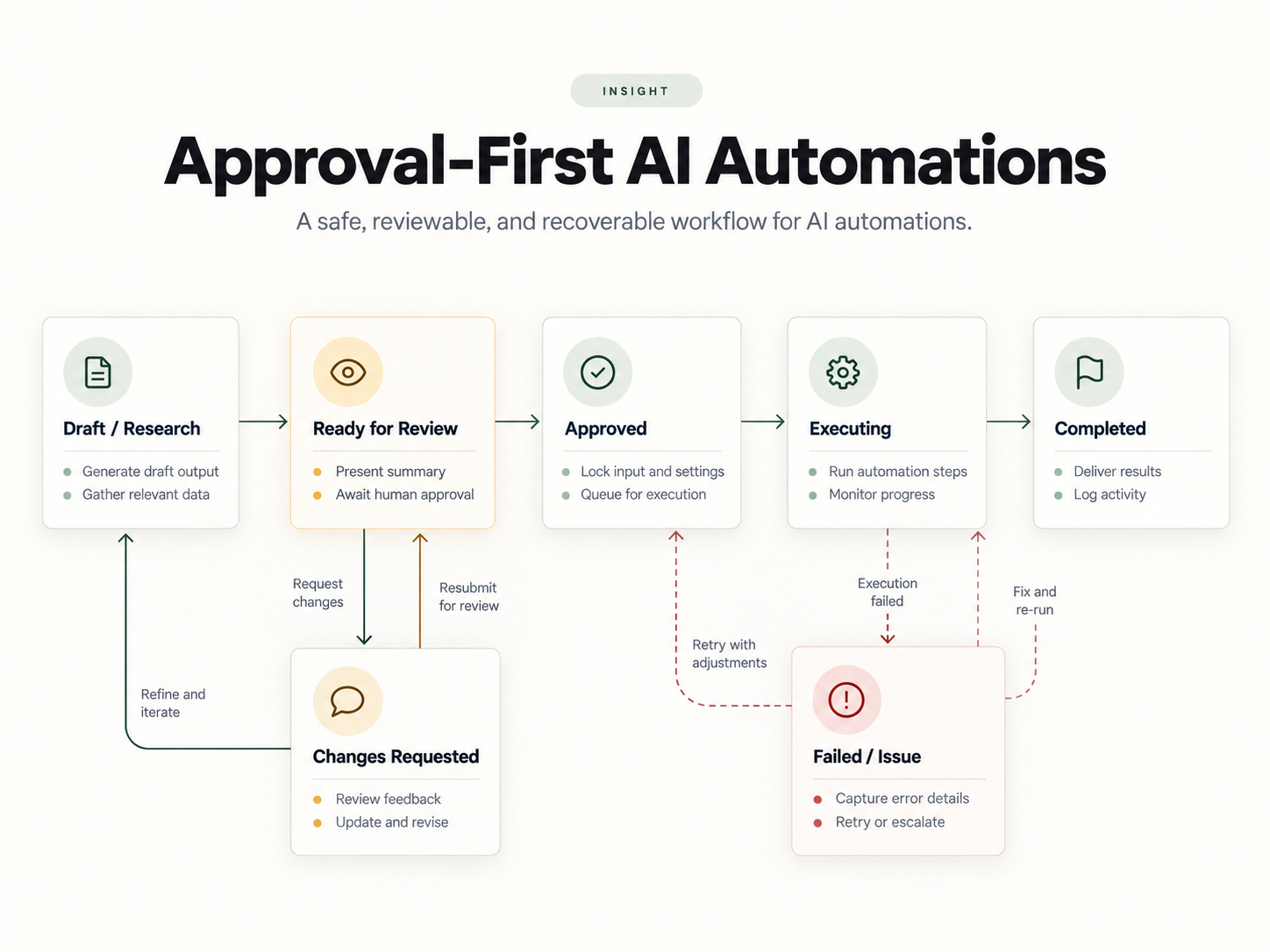
Approval should be data, not a sentence
A prompt that says ‘wait for approval’ is not a durable control. The system needs an explicit approval state stored outside the model response. That state can include the artifact version, approver, timestamp, comments, and permitted action. The execution step checks the state before it runs and refuses to proceed when the approval is missing, stale, or attached to a different version.
This prevents edited artifacts from being treated as approved after their content has changed. Version-aware approval links the decision to the exact content or structured payload that was reviewed. If the artifact changes materially, the workflow returns to review.
Make the human review small and specific
Human-in-the-loop systems fail when they create a queue of vague requests that nobody can evaluate quickly. A review task should show the proposed action, the information that supports it, important uncertainty, validation results, and the choices available. The reviewer should not have to reconstruct the entire automation history to decide.
I prefer bounded choices such as approve, request changes, reject, or escalate, with a short reason where useful. Free-form feedback can be included, but the workflow state should remain structured. This lets the system route changes back to the responsible stage and gives operators a meaningful view of what is waiting.
Use confidence to stop, not to justify everything
Confidence is useful when it changes behavior. High-confidence, low-consequence actions may continue automatically. Low-confidence interpretation, conflicting source data, missing required fields, or policy-sensitive content should stop for review. A confidence score without a defined threshold and fallback path is only decoration.
- Proceed automatically when inputs are complete, the rule is deterministic, and the action is reversible or low consequence.
- Request approval when the result affects an external audience, customer record, schedule, payment, or public system.
- Stop and ask when required information is missing, sources disagree, or the request falls outside the documented policy.
- Escalate when a person needs authority or context the automation cannot possess.
Status tracking is part of the product
Long-running operations need visible status. In an approval-driven content or business-operations system, I use named states rather than a single ‘in progress’ flag. An operator should see whether work is waiting on research, drafting, review, changes, approval, execution, or recovery from failure. Each state should indicate the current owner and the next permitted transition.
This also makes reminders safer. A reminder can target the person who owns a pending review after an appropriate interval instead of repeatedly re-running the AI step. Reminders should stop when the state changes and should not create duplicate tasks. Escalation rules can be added for time-sensitive workflows, but they should remain visible to the team.
Preserve a useful audit trail
Auditability does not require storing every hidden model detail. It requires enough public operational evidence to understand the decision. This includes the source inputs used, the generated artifact, validation results, approval state, actor, time, external action, and returned identifier or error. Sensitive content should still follow appropriate retention and access rules.
This record helps with debugging and accountability. If a published item contains a mistake, the team can determine whether the issue came from a source, a draft transformation, a review decision, or the execution integration. Without that separation, every incident becomes a search through an opaque chat transcript.
Design failed and uncertain states explicitly
An approved action can still fail. An API may time out, a destination may reject the payload, or permissions may change. Execution should record a failed state with a safe retry policy. The system must distinguish ‘approval granted’ from ‘action completed.’ It should not send a success message or advance the workflow until the external response has been validated.
Idempotency is important when retries can create duplicates. Where possible, the workflow should send a stable request identifier and check for an existing result before trying again. If the action cannot be made safely repeatable, recovery should return to a person with the relevant context rather than automatically looping.
When automation should stop and ask
Stopping is a capability, not a weakness. I want an automation to ask for help when it reaches a decision it cannot justify from approved information, when a request changes scope, when a required integration is unavailable, or when the next step carries authority the system was not given. A clear stop protects the business and gives the operator a useful intervention point.
Use review outcomes to improve the system
Approval-first design produces feedback that can improve the automation. Repeated change requests can reveal unclear source requirements, weak drafting instructions, missing validations, or a routing rule that no longer matches the business. The system can summarize these patterns for maintainers without removing the approval gate prematurely.
Over time, a well-understood subset may become safe to automate fully. That decision should follow observed reliability, clear policy, and recoverable execution rather than a desire to remove people from the diagram. Other steps may remain approval-based because the judgment itself belongs to a person.
Reliability is controlled progress
Reliable automation is not defined by the number of steps completed without human contact. It is defined by whether the workflow reaches accurate, authorized outcomes and makes uncertainty recoverable. Approval-first architecture gives generated work a place to be evaluated, gives consequential actions a clear authority boundary, and gives operators a record they can understand.
In business operations and content workflows, that structure often creates more practical automation, not less. AI handles preparation and repetition; deterministic workflow states coordinate progress; people retain judgment where it matters; and external actions occur only when the required evidence and approval are present.