An automated workflow that captures, qualifies, and routes incoming leads while keeping business systems updated.
Selected system 03
AI
Automation
CRM
Integrations
System in brief
A structured intake and routing workflow designed to turn an incoming enquiry into a clear, reviewable next step without losing the source information.
Problem
Lead information can arrive through different channels, in inconsistent formats, and without enough context for immediate routing. Manual triage can leave records incomplete and ownership unclear.
Stack
AI, Automation, CRM, Integrations
Outcome / current state
The workflow creates a consistent path from intake to routing and system update. No lead-volume or conversion improvement is published.
Overview
A structured intake and routing workflow designed to turn an incoming enquiry into a clear, reviewable next step without losing the source information.
Context / Problem
Lead information can arrive through different channels, in inconsistent formats, and without enough context for immediate routing. Manual triage can leave records incomplete and ownership unclear.
System Designed
Structured intake normalizes the information needed for qualification.
Business-rule logic evaluates the lead against explicit routing criteria.
Qualified records are sent to the appropriate next step or owner.
CRM or data updates keep the system of record current.
Ambiguous cases move to a human handoff instead of being forced through automation.
Architecture / Workflow
01Lead captured→
02Data normalized→
03Qualification rules→
04Route or human review→
05CRM update→
06Workflow monitoring
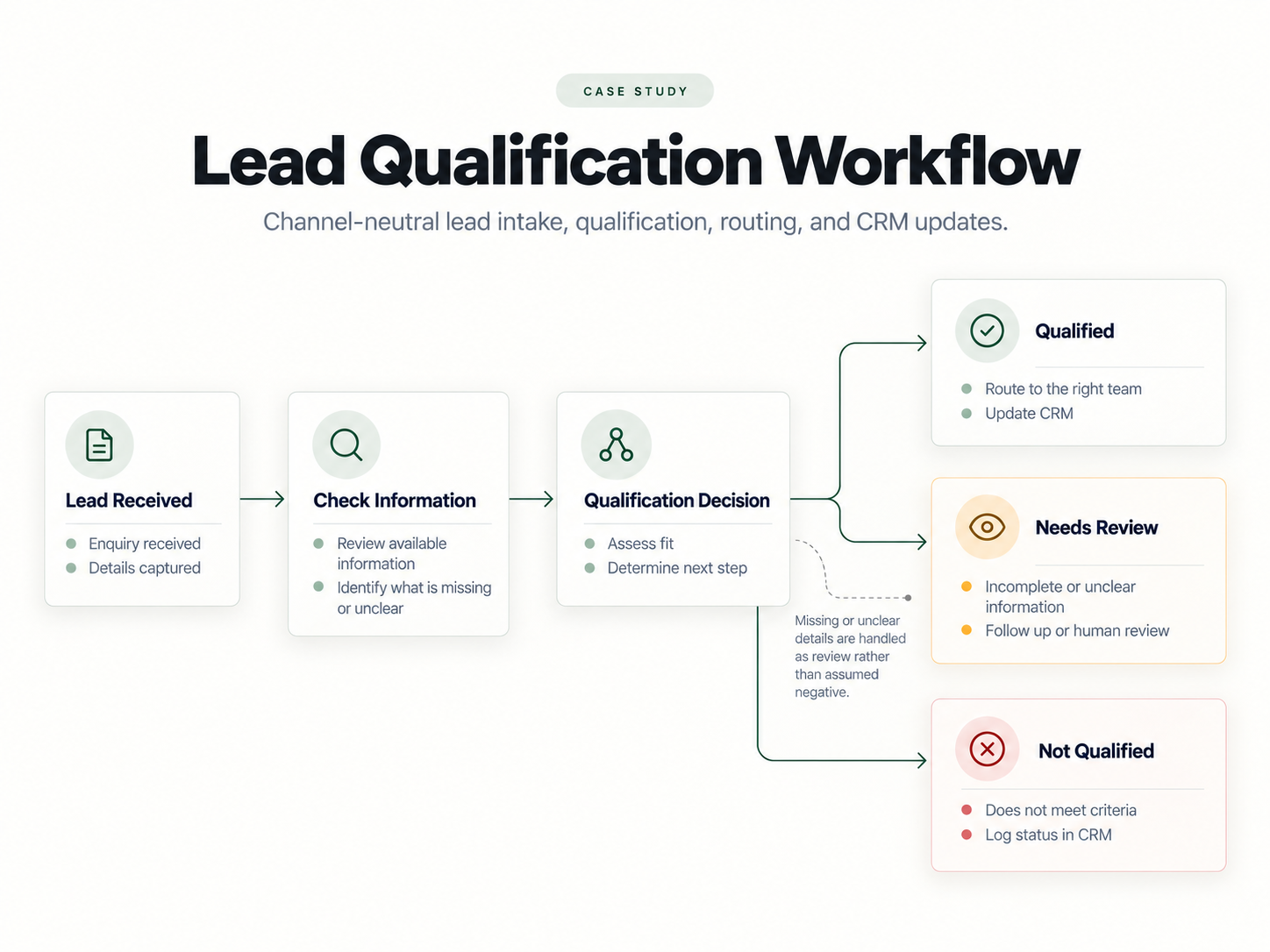
Conceptual decision flow
The exact production criteria are not published. This conceptual flow shows how the documented intake, qualification, routing, CRM update, and human-review principles fit together.
Lead receivedCapture the available enquiry without treating incomplete information as a decision.
Fields checkedNormalize the information needed for the next decision and preserve missing fields as unknown.
Qualification decisionApply visible business rules only when the required information is available.
Route, review, or follow upSend clear outcomes to the appropriate owner or next step and move ambiguous cases to human review or follow-up.
CRM updateRecord the structured outcome and route reason where the destination system supports it.
Implementation
Input fields and validation organized around the decisions the workflow must make.
Qualification logic expressed as reviewable business rules rather than hidden prompt behavior.
Routing branches map to clear owners or follow-up states.
Integration steps update the relevant system after the routing decision.
Constraints
Do not treat missing information as a negative qualification signal.
Keep business rules visible and changeable as the operating process evolves.
Preserve a human path for leads that do not fit the predefined branches.
Design Decisions
Normalize intake before applying qualification logic.
Separate routing rules from integration details so either can change independently.
Record the reason for a route when the destination system supports it.
Outcome
The workflow creates a consistent path from intake to routing and system update. No lead-volume or conversion improvement is published.
Lessons / Notes
Reliable qualification starts with clear intake, not a more complex scoring model.
Exception handling prevents uncertain data from becoming a confident automated decision.
Related guidance
Read the AI voice-agent design guidanceThe same qualification, structured-data, CRM, and handoff considerations apply when intake begins in a live conversation.
How should AI decide whether a lead is hot, warm or cold?
The categories should come from explicit business rules, not from an AI model inventing its own definition of lead quality. The workflow can extract structured facts, validate required fields, and apply the approved criteria with a reason for the route. Uncertain or incomplete cases should remain unclassified or move to review.
What should an AI lead qualification system do when a lead gives vague or incomplete answers?
It should preserve missing information as unknown and ask a focused follow-up only when the answer is necessary for the next decision. If ambiguity remains, the workflow should record its confidence and route the case to follow-up or human review. It should not convert missing data into a negative qualification signal.
Should AI automatically reject leads that do not qualify?
AI should not automatically reject a lead unless the business has approved clear, low-risk rules for that outcome. Consequential, borderline, or uncertain decisions need a review or alternative routing path. Even deterministic rejections should preserve the reason so the decision is explainable and auditable.
How do you prevent AI lead qualification from filling the CRM with bad or unstructured data?
Define a structured schema and validate required fields, allowed values, formats, and source information before writing to the CRM. Duplicate checks and controlled update rules prevent repeated or conflicting records. Ambiguous values should be marked for review rather than stored as confirmed facts.
Can sales teams trust AI lead scoring without human review?
AI lead scoring is most useful as decision support, not as an unquestionable source of truth. Teams should see the factors and business rules behind a route, while uncertain or high-impact cases remain reviewable. Human oversight can be lighter for well-tested, low-risk decisions with clear evidence and recovery controls.