Voice AI

AI Voice and CRM System

A conversational voice system for handling calls, qualifying leads, scheduling next steps, and synchronizing business data.

Selected system 02
  • Retell / Vapi
  • Make
  • CRM
  • APIs

A voice workflow designed to connect a live conversation with qualification logic, scheduling, CRM updates, and a clear route to human follow-up.

Problem
Call handling often spans several systems and decisions. Capturing the conversation is only one part of the job; the workflow also needs to qualify intent, choose a next step, update records, and escalate when the conversation moves outside its safe scope.
Stack
Retell / Vapi, Make, CRM, APIs
Outcome / current state
The design links the conversation to an operational next step and a maintained business record. No performance or conversion metrics are claimed.

Overview

A voice workflow designed to connect a live conversation with qualification logic, scheduling, CRM updates, and a clear route to human follow-up.

Context / Problem

Call handling often spans several systems and decisions. Capturing the conversation is only one part of the job; the workflow also needs to qualify intent, choose a next step, update records, and escalate when the conversation moves outside its safe scope.

System Designed

  • Inbound or outbound conversational flows follow a defined purpose and boundary.
  • Qualification questions collect only the information required for the next decision.
  • Scheduling logic proposes an appropriate next step when the conversation qualifies.
  • CRM synchronization keeps the operational record aligned with the call outcome.
  • Human escalation remains available for exceptions and sensitive conversations.

Architecture / Workflow

01Call begins
02Conversation and intent capture
03Qualification rules
04Schedule or escalate
05CRM synchronization
06Review conversational behavior
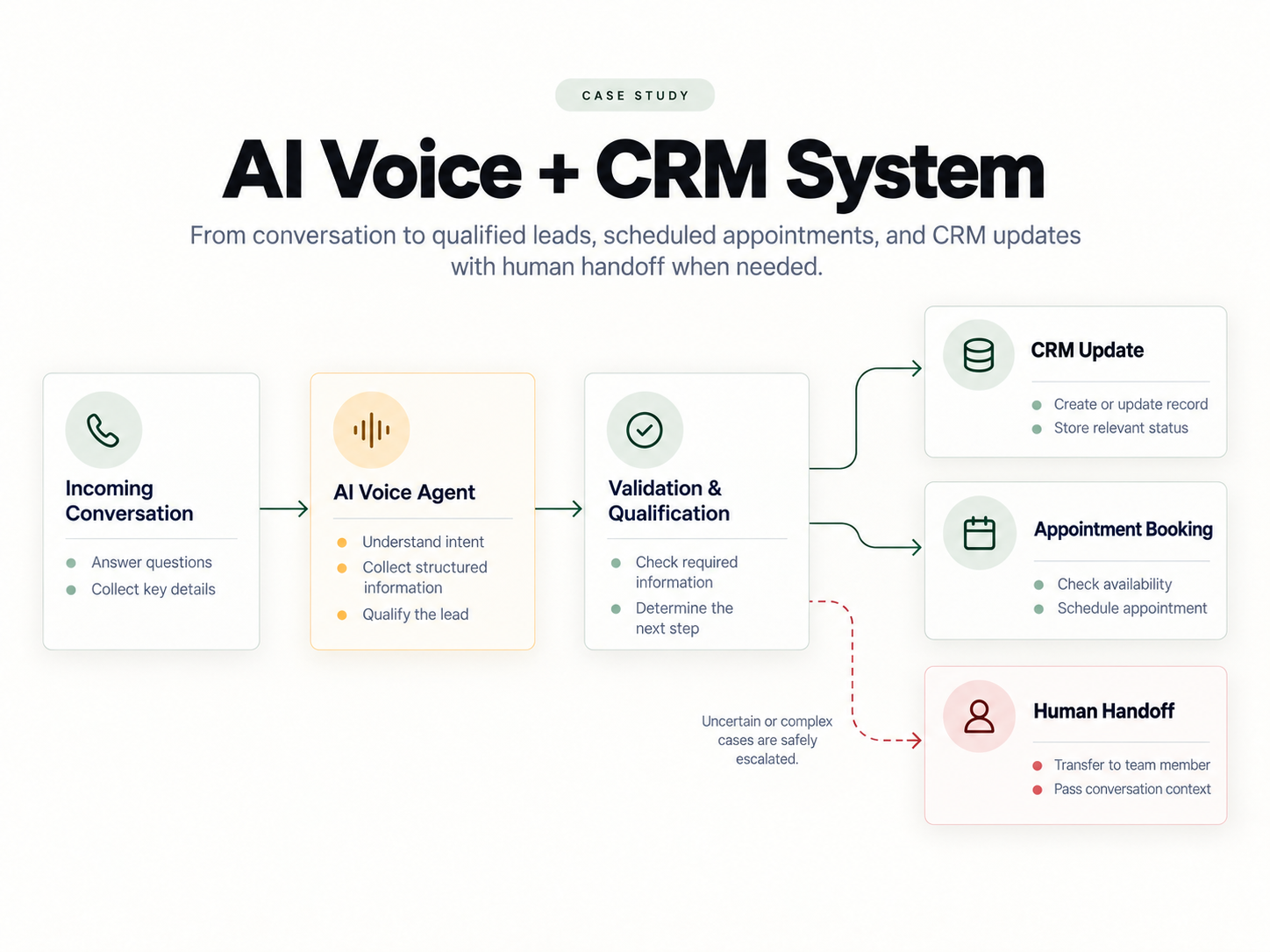
AI Voice and CRM workflow showing conversation intake, AI qualification, CRM updates, appointment booking, and human handoff.

Data handling boundary

The exact production field list is not published. This boundary reflects the documented design constraints for conversation data and CRM synchronization.

Collected for the next decision
Conversation details are requested only when they support qualification, scheduling, escalation, or the next operational step.
Validated before a CRM write
Structured call data is checked against the relevant business rules before it is written as confirmed information.
Uncertain or incomplete data
Ambiguous details are not represented as confirmed. They move to a recoverable state, human handoff, or follow-up path instead.
External outcomes
A scheduling or CRM action is confirmed only after the connected tool response has been validated.
Implementation

  • Conversation paths designed around the caller's likely intent and common exceptions.
  • Business rules separate a qualified next step from an escalation or follow-up task.
  • API and automation steps move structured call data into the CRM.
  • Test scenarios cover phrasing variation, incomplete answers, and requests outside the intended scope.

Constraints

  • Keep the conversation useful without presenting the system as a replacement for human judgment.
  • Avoid writing incomplete or ambiguous call data into the CRM as confirmed information.
  • Support multiple voice-platform options without implying they are always used together.

Design Decisions

  • Use Retell or Vapi according to the implementation context rather than coupling the architecture to both.
  • Make escalation a normal path, not an error state.
  • Keep CRM updates structured so operators can understand what came from the conversation.

Outcome

The design links the conversation to an operational next step and a maintained business record. No performance or conversion metrics are claimed.

Lessons / Notes

  • A voice system should be tested as a conversation and as a data workflow.
  • Clear escalation rules are as important as a polished happy path.

Related guidance

Practical questions about this system

Can an AI voice agent book appointments directly into a CRM or calendar?

Yes, an AI voice agent can request a booking through a controlled tool call to an API, webhook, or automation layer. The workflow should validate availability, required caller details, and the returned booking result before it confirms success. A failed or uncertain response should move to a fallback or human follow-up path.

How do you stop an AI voice agent from creating incorrect CRM records or bookings?

Validate critical details and the intended action before any CRM write or booking request. Required-field checks, normalized data, duplicate detection, idempotency controls, and confirmation of names, dates, and contact details reduce incorrect records. The agent should never describe an external action as complete until the connected system confirms it.

When should an AI voice agent transfer a caller to a human?

Transfer when the caller requests a person, the conversation leaves the approved scope, required information remains uncertain, or the decision carries sensitive or consequential judgment. Transfer rules should be defined as normal workflow paths with the relevant context attached. If a live transfer is unavailable, the system should create a clear follow-up state instead of pretending the issue was resolved.

Can an AI receptionist handle missed calls and after-hours leads effectively?

Yes, it can handle bounded after-hours intake by identifying the request, collecting verified contact details, and assigning an appropriate next step. It should set accurate expectations about response times and avoid making commitments it cannot verify. Urgent, sensitive, or out-of-scope calls still need a defined escalation or fallback route.

How do you safely test an AI voice agent with a production CRM?

Use a sandbox, separate test account, or clearly isolated test records before allowing writes to live customer data. Test payloads should be identifiable, permissions should be narrow, and booking or CRM actions should have cleanup and duplicate-prevention controls. Production access should begin only after failure paths, validation, and human handoff have been exercised.

Next projectLead Qualification Workflow